
Truly Preserved is reader-supported. If you buy through a link on this page we may earn a commission at no extra cost to you. Nobody pays for placement or scores.
THE SHORT ANSWER
Most ferment problems trace to five things the sources name: salt, temperature, submersion, time, and cleanliness. The discard lines are the sources’ own words: the National Center for Home Food Preservation says that if fermented pickles become soft, slimy, or develop a disagreeable odor, discard them — and University of Illinois Extension’s rule for the whole category is “when in doubt, throw it out”: if a fermented product is slimy or smells spoiled or rotten, discard it. A healthy ferment, by contrast, reaches a pH of 4.60 or lower with bubbling stopped, per University of Minnesota Extension. This page renders no verdict beyond what those sources print. Every figure on this page comes from the tested sources credited at the bottom.
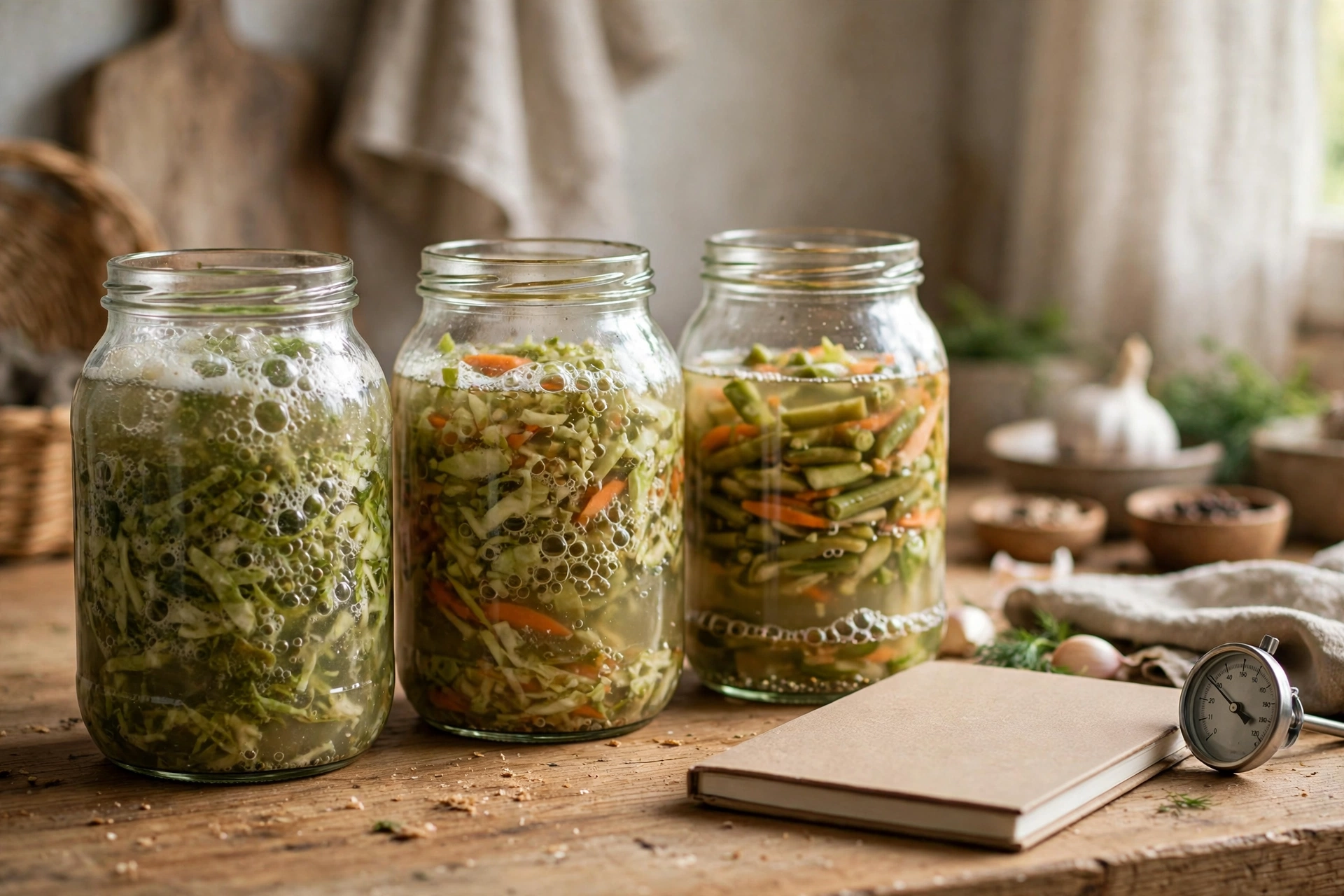
Every fermenter eventually stands in front of a jar asking the same question: is this right, or is this ruined? This guide is the category’s answer key, built only from the criteria the tested sources themselves publish — the National Center for Home Food Preservation’s fermenting guidance, Minnesota Extension’s fermentation controls, and Illinois Extension’s fermenting handout. Where a source gives a test, the test is printed. Where a source gives a discard line, the line is printed in its own terms. Nothing here upgrades a guess into a verdict: if your jar does not match a case below, the sources’ shared default applies — when in doubt, throw it out.
This guide is part of our preservation guides and closes the fermenting category that starts with how to make sauerkraut. Read it beside the guide for the ferment in front of you — fermented dill pickles and kimchi carry their own source-specific checks as well.
What You Need
Troubleshooting runs on measurement, not nerve: a way to test pH, because Minnesota Extension’s finish test is a pH of 4.60 or lower; a thermometer, because the same source says to measure the air temperature around the ferment; and the salt the recipes specify — canning or pickling salt, because the National Center notes that flake salt varies in density and is not recommended for pickled and fermented foods, which makes spoon-measured flake salt a prime suspect in any batch that went wrong. The container rules matter to diagnosis too: food-grade plastic, ceramic, or glass, never metal, and 1 gallon of container for every 5 pounds of fresh vegetables on Illinois Extension’s planning figure.

ThermoPro Instant-Read Thermometer
Temperature is the first check in every troubleshooting case, and a thermometer is how you measure the air around the ferment against the 68 to 72 degree band instead of guessing.
$8.99 from Amazon
Morton Canning and Pickling Salt, 4 lb
Wrong salt is a named cause of failed ferments, and this canning and pickling salt replaces the flake or iodized salt that spoon-measuring makes unreliable.
$2.68 from Amazon
Etekcity Digital Kitchen Scale
Salt errors are weighing errors, and a kitchen scale is how the next batch's salt gets measured against the produce weight the tested ratios are written for.
$9.99 from AmazonBefore You Start
One boundary before any symptom: this page does not clear food. The sources give criteria — a pH line, temperature bands, and discard descriptions — and a jar that meets a discard description is discarded, not tasted into compliance. Minnesota Extension’s monitoring rule is the working method: test the pH of the brine throughout fermentation, and if bubbling has stopped but the pH is still above 4.60, continue to ferment and check the pH every 1 to 2 days. A ferment that never reaches the line is a ferment the sources never call finished.
How to Troubleshoot a Ferment, Step by Step
- Check the temperature first. Minnesota Extension: between 68 and 72 degrees Fahrenheit is ideal; temperatures over 78 degrees can cause over-fermentation and spoilage, and temperatures below 60 degrees will inhibit fermentation. The National Center’s sauerkraut figures agree in shape: at 70 to 75 degrees kraut ferments fully in about 3 to 4 weeks, at 60 to 65 degrees it may take 5 to 6 weeks, below 60 degrees it may not ferment, and above 75 degrees it may become soft. A silent jar in a cold room is usually a cold jar, not a dead one — move it into the band and give it the source’s time.
- Check the salt. Too much salt is a named failure: if there is too much salt in the brine, Minnesota Extension states, fermentation will not occur and the pH will not drop to become more acidic. Too little is the opposite failure, and the National Center’s caution covers it: do not attempt to make sauerkraut or fermented pickles by cutting back on the salt required, because in fermented foods salt favors the growth of desirable bacteria while inhibiting the growth of others.
- Check the submersion. The produce belongs 1 to 2 inches below the brine — Illinois Extension’s figure — in a low-oxygen environment, because exposure to oxygen encourages mold and yeast growth. Anything floating at the surface is where surface growth starts; reweight the jar and restore the cover.
- Read the surface the way the sources do. Surface scum forms on working ferments, and the pickle procedure’s instruction is to check the container several times a week and promptly remove surface scum or mold; the sauerkraut procedure, for crocks weighted with jars, says to check 2 to 3 times each week and remove scum if it forms. Skimming is maintenance the sources describe — it is not a rescue for a batch that meets a discard line below.
- Apply the discard lines exactly as written. Pickles: if they become soft, slimy, or develop a disagreeable odor, discard them. Kimchi in storage: discard if you observe indications of surface mold. Kombucha: fuzzy blue, gray, green, brown, or black mold means discard the SCOBY and kombucha and thoroughly wash the vessel. Any fermented product that is slimy or smells spoiled or rotten: discard it, clean and sanitize the container thoroughly, and try again — Illinois Extension’s closing instruction, under its heading “When in doubt, throw it out.”
- Confirm the finish before eating. Minnesota Extension’s endpoint: when a pH of 4.60 or lower is reached and bubbling has stopped, the ferment is ready. Kimchi carries the same line in its own source — a pH of 4.6 or below before consuming, with an optimum of 4.2. No pH line met, no finished ferment.
The Numbers: The Checks That Decide
| Check | Source value |
|---|---|
| Ideal fermentation temperature (UMN) | 68 to 72 degrees Fahrenheit |
| Spoilage risk above (UMN) | Over 78 degrees Fahrenheit |
| Fermentation inhibited below (UMN) | Below 60 degrees Fahrenheit |
| Sauerkraut temperature and time (NCHFP) | 70 to 75 degrees F, about 3 to 4 weeks; 60 to 65 degrees F, 5 to 6 weeks; below 60 degrees F may not ferment; above 75 degrees F may become soft |
| Pickle softening above (NCHFP) | Above 80 degrees Fahrenheit |
| Finish pH (UMN) | 4.60 or lower, and bubbling stopped |
| pH recheck interval (UMN) | Every 1 to 2 days |
| Kimchi safety pH (CSU) | 4.6 or below before consuming; optimum 4.2 |
| Submersion (Illinois / UMN) | 1 to 2 inches below the brine |
| Scum checks, pickles (NCHFP) | Several times a week, remove promptly |
| Scum checks, sauerkraut with jar weights (NCHFP) | 2 to 3 times each week |
| Container planning (Illinois) | 1 gallon for every 5 pounds of fresh vegetables |
Most rescued ferments turn out to have been cold, floating, or under-salted — and the fix for the next batch is the measuring shelf: the scale, the salt, and the thermometer that keep the five controls inside their bands.

SOLIGT Glass Fermentation Weights, 4-Pack
Floating produce is where surface growth starts, and glass weights restore the 1 to 2 inches of brine cover the troubleshooting steps tell you to check.
$11.99 from Amazon
ThermoPro TP49 Hygrometer
A room unit with a temperature readout watches the fermenting corner continuously, so a cold-room stall gets caught in days instead of at the two-week check.
$8.54 from AmazonCommon Mistakes
Tasting to decide. None of the sources uses taste as a safety test. The tests are a pH reading, a temperature, and the discard descriptions — soft, slimy, disagreeable odor, spoiled or rotten smell. A jar you are unsure about falls under Illinois Extension’s rule: when in doubt, throw it out.
Cutting the salt next time because this batch was salty. The National Center’s caution is explicit: do not attempt fermented pickles or sauerkraut by cutting back on the salt required. Salt is the control that favors the desirable bacteria; a bland batch is fixed by recipe choice, not by weakening the ferment’s safety mechanism.
Measuring flake salt by the spoon. Flake salt varies in density and is not recommended for fermented foods, per the National Center. A batch salted with spooned flakes may carry far less salt than the recipe intends — weigh salt, and use canning or pickling salt.
Leaving surface growth alone. The procedures say to remove surface scum promptly, on a schedule of several times a week for pickles and 2 to 3 times each week for jar-weighted kraut. Neglected scum is how a working ferment becomes a discard case.
Fermenting in the wrong container. Metal reacts with the lactic acid the bacteria produce, per Minnesota Extension, and Illinois Extension adds: do not use copper, iron, or galvanized metal containers or lead-glazed crocks, and if the safety of the container is in question, err on the side of caution. Some mystery failures are container failures.
Storage and Shelf Life
A ferment that passes its finish test stores by its own guide’s figures: Minnesota Extension keeps fermented produce refrigerated for up to 9 months, with refrigeration stopping the fermentation process; the National Center keeps fully fermented pickles refrigerated for about 4 to 6 months with scum and molds removed regularly, and fully fermented kraut tightly covered in the refrigerator for several months; Colorado State’s kimchi is eaten within 2 weeks for best quality. A discarded batch’s container gets cleaned and sanitized thoroughly before the next attempt, per Illinois Extension.
Viewers also searched for these items.

Ball Regular Mouth Canning Lids, 96 Count
Fresh lids restore the airtight cover the method requires on mason-style jars, replacing lids that acidic brine has degraded over a long ferment.
$36.99 from Amazon
Mrs. Wages Pickling and Canning Salt
A second bag of pickling salt keeps the specified salt on hand for the retry batch, so a corrected ferment is not improvised with whatever salt is in the cupboard.
$19.32 from Amazon
FoodSaver Elite Vacuum Sealer
A sealer is the bench spare for the overflow produce a discarded batch leaves behind, freezing it for cooked use instead of forcing a second risky ferment.
$218.56 from AmazonFrequently Asked Questions
My ferment has stopped bubbling. Is it done?
Only if the pH agrees. Minnesota Extension: when a pH of 4.60 or lower is reached and bubbling has stopped, the ferment is ready — and if bubbling has stopped but the pH is still above 4.60, continue to ferment and check the pH every 1 to 2 days.
There is scum on top. Is the batch ruined?
Scum is expected maintenance in the sources: the pickle procedure says to check several times a week and promptly remove surface scum or mold, and the kraut procedure sets checks at 2 to 3 times each week for jar-weighted crocks. Skim it, restore the brine cover — and if the food itself is soft, slimy, or disagreeable in odor, the discard line applies instead.
What are the exact signs that mean throw it out?
In the sources’ words: pickles that become soft, slimy, or develop a disagreeable odor are discarded; a fermented product that is slimy or smells spoiled or rotten is discarded; kimchi showing indications of surface mold in storage is discarded; kombucha with fuzzy blue, gray, green, brown, or black mold is discarded with its SCOBY. And the category default, from Illinois Extension: when in doubt, throw it out.
My kraut did nothing for two weeks. What happened?
Check the room first. Below 60 degrees Fahrenheit, the National Center says kraut may not ferment, and Minnesota Extension puts inhibition below 60 degrees generally. At 60 to 65 degrees the same kraut may take 5 to 6 weeks. Cold is the most common stall — and too much salt is the other named one, since excess salt prevents the pH from dropping.
Discard criteria, salt caution, and fermentation temperatures and times: National Center for Home Food Preservation, “General Information on Fermenting” and the USDA Complete Guide to Home Canning, Guide 6 procedures, via the National Center for Home Food Preservation; pH finish test and temperature bands: University of Minnesota Extension, “Preserving food at home: Fermentation”; “when in doubt, throw it out” and submersion and container rules: University of Illinois Extension, “Fill Your Pantry: Fermenting Foods.”
Prices shown on this page were last checked November 26, 2026 — prices change; check before you buy.
Talk it over with other readers
The Truly Preserved Community on Facebook is where readers compare notes on food storage, water, and backup power — and where your questions help decide what we research next.