
Truly Preserved is reader-supported. If you buy through a link on this page we may earn a commission at no extra cost to you. Nobody pays for placement or scores.
THE SHORT ANSWER
Because 72 hours was never a promise about how long an outage lasts — it was a floor for how long help might take to reach you. The agencies have quietly split the old single number in two: 3 days is now the evacuation and get-started floor, and 2 weeks at home is the target the American Red Cross and the CDC point households toward. At 1 gallon per person per day, a family of four needs 12 gallons for the old 72 hours and 56 gallons for two weeks. The three-day kit still matters. It just stops being the whole plan on the morning of day four, when the boil notice, the closed treatment plant, or the ice storm is still going.
Ask a room of prepared households how much water to store and most of them will give you the same sentence they learned years ago: three days, a gallon a person a day. It is not a wrong sentence. It is a half-finished one, and the missing half is in the agencies’ own current pages, in wording most people skim past — “several days” here, “if possible” there, a two-week line in a kit list nobody reads to the bottom. Put those pages side by side and the 72-hour rule does not disappear. It gets demoted, from the plan to the first step of the plan.
What do the agencies actually say today — side by side?
The agencies actually say three different durations, for three different jobs, and the confusion starts when they are quoted as one number. Ready.gov, FEMA’s preparedness site, says you may need to survive on your own for several days after a disaster and lists water at 1 gallon per person per day for drinking and sanitation — it does not pin its kit to the number three. The CDC is more specific about water: store at least 1 gallon per person per day for at least 3 days, and try to store a 2-week supply if possible. The American Red Cross splits it by situation in a single line: a 3-day supply of food and water for evacuation, and a 2-week supply for staying home, with a 7-day supply of medications alongside.
| Source | Evacuation / floor | At-home target |
|---|---|---|
| Ready.gov (FEMA) | Several days | Several days |
| CDC (water) | At least 3 days | 2 weeks if possible |
| American Red Cross | 3 days to evacuate | 2 weeks at home |
Read that table the way it was written and the “change” is not that anyone tore up the 72-hour rule. It is that the two-week home supply — the number that was always in the Red Cross kit list — turned out to be the one that matches how long real water problems run, while the three-day figure matches a bag you can carry out the door. Both numbers are official. They were never meant to be the same kit.
Where did the 72 hours come from in the first place?
The 72 hours came from response time, not repair time. The idea underneath it is that in a major disaster, outside help and restored services take roughly three days to reach a household in force — so a household that can cover its own first three days is not competing for the first truck that arrives. That is a sensible floor for a go-bag. It says nothing about when the water plant is repaired, the boil notice is lifted, or the ice comes off the lines, because those clocks were never the ones the 72-hour figure was counting. Treating a response-time floor as a restoration promise is the whole error, and it is an error of reading, not of agency dishonesty — the same pages that print three days have carried the two-week home line for anyone who read to the bottom.

Saratoga Farms 5-Gallon Stackable Water Storage
The jump from 3 days to 2 weeks is mostly a container problem, and 5-gallon stackables are the build-it-gradually answer this page points to — fill one at a time, stack them, and the two-week supply grows without one huge drum.
$318.79 from Amazon
waterBOB Bathtub Water Bladder
For the warning-days scenario — a storm coming, a boil notice likely — the waterBOB turns a standard tub into emergency storage you fill in minutes, covering the gap while the longer-term supply gets built.
Check AvailabilityHow long do water problems actually run?
Water problems run longer than three days often enough that the longer cases are not freak events. A boil-water notice after a main break or a treatment failure is measured in days of testing after the repair, not hours. A hurricane or an ice storm that takes down power to a treatment plant stacks two repairs — power first, water second — and a household at the end of that chain waits for both. The February 2021 Texas freeze is the example most Texas households need no persuading on: power failures cascaded into water-system failures, and boil-water notices ran well past three days across much of the state. None of that makes two weeks a guarantee either. It makes the arithmetic plain: a supply sized to the shortest plausible outage fails in every outage that is not the shortest.
What does the jump from 3 days to 2 weeks actually weigh?
The jump from 3 days to 2 weeks weighs about 367 more pounds for a family of four — and that weight, not the gallon count, is where the plan usually stalls. At 1 gallon per person per day:
| Household | 3 days | 2 weeks |
|---|---|---|
| 1 person | 3 gallons | 14 gallons |
| 2 people | 6 gallons | 28 gallons |
| Family of four | 12 gallons | 56 gallons |
Water weighs about 8.34 pounds a gallon, so the family-of-four two-week supply is roughly 467 pounds in total. Nobody stores that as one object. It splits — some under beds, some in a closet, a drum in a garage — which is why the container question is a two-week question and barely matters at three days. Our two-week water math for a family of four itemizes the extras the baseline leaves out, and our per-person water page works through why the European figures look smaller (they count drinking and cooking, not sanitation).
The options that make 56 gallons storable in a real house are the ones in our water storage containers comparison:
- Saratoga Farms 5-gallon stackables — the apartment-and-closet route: twelve 5-gallon jugs stack the two-week family supply into a footprint a drum cannot fit.
- Augason Farms 55-gallon kit — one drum is 55 of the 56 gallons, for a house with a garage corner to give it.
- waterBOB bathtub bladder — the warning-based layer: it holds up to 100 gallons in a tub when a storm gives you hours of notice, and stores in a drawer when it does not.
Prices last checked: November 7, 2026 — no prices are printed on this page; the containers comparison carries its own verified prices and the finished cost per gallon for each option.

ProOne Big+
The gravity system for water that sat longer than you meant it to — treat it on the way out.
$160.97 from Amazon
LifeStraw Home
Certified for lead, mercury, chlorine, and PFAS/PFOA/PFOS — in a glass pitcher.
$51.99 from Amazon
AquaTru Classic
The most lab-certified contaminant removal of the group — but it needs electricity, so it's dead in a power outage.
$380.00 from AmazonWhat eats the baseline before two weeks are up?
Heat, cooking, illness, and pets eat the baseline, in roughly that order. Ready.gov warns that individual needs vary and can double in very hot weather — a two-week supply in a hot climate, planned honestly, is not 56 gallons for four people but closer to 112. Freeze-dried food is the quiet second drain: the gallon covers drinking and minimal hygiene, and rehydrating a freeze-dried pantry adds roughly 14 gallons for a family of four across two weeks. Children, nursing mothers, and anyone sick need more than the baseline, and the CDC adds pets and pregnancy to the same list. None of these extras argues against the two-week target. They argue that a household which stores exactly 56 gallons and calls it two weeks has really stored something closer to ten honest days — still three times the old kit, and worth knowing precisely rather than discovering on day eleven.
Is the new number 30 days — or 90?
No — neither 30 days nor 90 days is household guidance from any US agency, and the recent headlines that suggest otherwise are about a different subject. The 90-day figure moving through the news this fall traces to reported military-base planning under the Pentagon’s FORTRESS program — a requirement discussed for installations to sustain their own operations. It is not a FEMA, CDC, or Red Cross instruction to households, and no agency page we read asks a family to store 90 days of water — which, at the baseline, would be 360 gallons for four people. Thirty days is a personal choice some households make for food, where cans and buckets stack dry; for water it runs into the weight and space wall above. The household numbers remain the modest ones in the table at the top of this page: several days as the floor, two weeks at home as the target. Build to those before borrowing a number written for an army base.
How do you build from 3 days to 2 weeks without doing it all at once?
You build it the way the Red Cross split already suggests: keep the 3-day supply as a distinct, portable kit, and grow the home supply separately, a container at a time. A case of bottled water on each grocery run is a real method — it is how most two-week supplies actually happen. Fill the container you can store this month, date it, and put the rotation on a calendar; home-filled water is replaced every six months on the Ready.gov and CDC interval, and our stored tap water page covers the sanitizing and rotation routine. And hold the second half of the plan beside the first: treatment capacity. Two weeks of stored water plus the means to purify more water in an emergency — a pot, a fresh bleach bottle with its dose, a filter — covers the outage that runs past your shelves, which no amount of jug-stacking alone can promise.

Grayl GeoPress
The only portable here that handles viruses — built for travel, not daily home use.
$99.95 from Amazon
Questions people also ask
Did FEMA officially change its recommendation from 3 days to 2 weeks?
FEMA’s own site, Ready.gov, phrases its kit in days without fixing a single number — “several days” — and lists the gallon-per-person-per-day baseline. The explicit 3-days-to-evacuate / 2-weeks-at-home split is the American Red Cross’s, and the CDC’s water page pairs a 3-day minimum with “try to store a 2-week supply if possible.” So there was no single press-release moment when 72 hours became 14 days; there is a set of current pages in which the home target is consistently two weeks and the three-day figure is consistently the portable floor.
How much water is a 72-hour supply, exactly?
A 72-hour supply at the agency baseline is 3 gallons per person — 12 gallons for a family of four, about 100 pounds. That is the evacuation and first-days kit: enough to drink, brush teeth, and wash minimally for three days, with nothing in it for heat, illness, pets, or cooking freeze-dried meals beyond a minimal allowance.
Should I store two weeks of food as well as water?
The Red Cross kit list pairs them — 2 weeks of food and water at home — and food is the easier half to store, because it is dry, light per calorie, and does not need rotation on a six-month clock. Our page on how much food a family needs for 3 days, a week, and 2 weeks gives the calorie totals by duration — 24,000, 56,000, and 112,000 calories for a family of four — so the food side can be built to the same two-week line as the water.

Augason Farms 55-Gallon Water Storage Kit
The single-container route to a family's two-week water baseline — this page weighs the drum option directly, and the kit bundles the barrel with the treatment and pumping pieces a bare drum leaves you to source.
Check Availability
ReadyWise 72-Hour Emergency Food and Drink Supply
Stretching water to two weeks does not retire the 72-hour kit — it becomes the first layer you actually eat from, and this one covers 3 days of food for the grab-and-go end of the plan.
Check Availability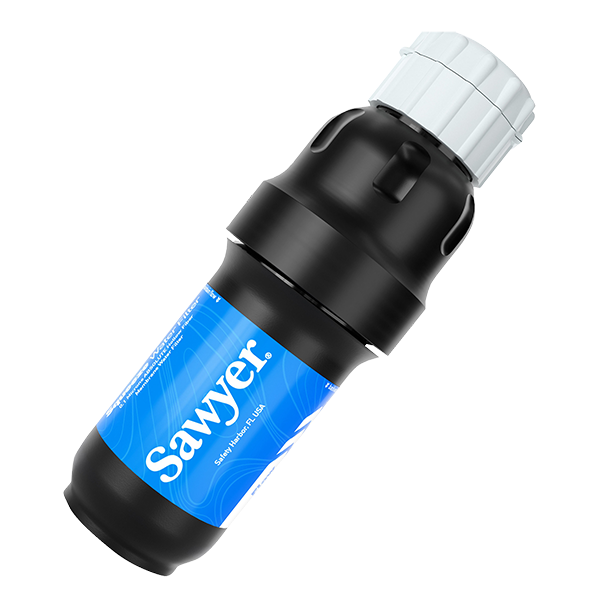
Sawyer Squeeze
Water that has sat in storage for months gets filtered before it is drunk in this house — the Squeeze is the small hollow-fiber filter for running stored water through at the jug scale, then disinfecting as the full method requires.
Check AvailabilityFAQ
Why is the 72-hour water supply no longer enough?
Because 72 hours measures how long outside help may take to arrive, not how long a water outage lasts. Current agency guidance keeps 3 days as the evacuation floor and points households to a 2-week supply at home — the Red Cross states that split directly, and the CDC advises storing at least 3 days of water and trying for 2 weeks if possible. At 1 gallon per person per day, that is 56 gallons for a family of four instead of 12.
How many gallons does a family of four need for two weeks?
Fifty-six gallons at the baseline of 1 gallon per person per day — about 467 pounds of water, split across containers and rooms. Hot weather can double the need, and rehydrating freeze-dried food adds roughly 14 gallons across the two weeks, so a household planning honestly for summer or a freeze-dried pantry stores more than 56 or pairs the 56 with treatment capacity.
Is a 3-day kit still worth having?
Yes. Three days is the supply you can leave with — the Red Cross’s evacuation figure — and the first three days of any longer outage at home. The mistake is not owning a 72-hour kit; it is owning only a 72-hour kit and believing the number was a promise about day four.
Related questions
- How do I purify water in an emergency?
- How Much Water Should I Store Per Person Per Day?
- How Much Water Does a Family of Four Need for Two Weeks?
- How long can you store tap water — and do you treat or rotate it?
Sources: Ready.gov (FEMA), “Build a Kit” and “Water” (households may need to survive on their own for several days; 1 gallon of water per person per day for drinking and sanitation; individual needs vary, children, nursing mothers, and sick people need more, and needs can double in very hot weather; water not commercially bottled should be replaced every six months); CDC, “How to Create an Emergency Water Supply” (store at least 1 gallon per person per day for at least 3 days, try to store a 2-week supply if possible; store more for pregnant women, sick people, pets, and hot climates); American Red Cross, Survival Kit Supplies (1 gallon per person per day; a 3-day supply for evacuation and a 2-week supply for home; a 7-day supply of medications). The 90-day figure is discussed in this page only as reported military-base planning under the FORTRESS program, not as household guidance, consistent with those agencies’ published pages. No product prices are printed on this page. Prices last checked: November 7, 2026.
This question sits under the water questions readers ask us most — the full set is gathered here: What People Are Asking About Water Storage.
Talk it over with other readers. The Truly Preserved Community on Facebook is where readers compare notes on food storage, water, and backup power — and where your questions help decide what we research next. Join the group →
Viewers also searched for these items.

ZeroWater 12-Cup
A five-stage pitcher that strips dissolved solids down to zero on its included meter — a useful everyday backup when the big gravity can is stored away or already spoken for.
$27.99 from Amazon
Katadyn BeFree AC
The trail favorite: a soft bottle with the filter in the cap — fill, squeeze, drink. The backpacking world's default for fast water.
$49.95 from Amazon
TeraPump Drum Pump
A siphon pump sized for 55-gallon drums — battery-powered transfer at several gallons a minute, so filling a carry jug is a minute's work instead of a wrestling match.
$39.99 from AmazonPrices shown on this page were last checked November 26, 2026 — prices change; check before you buy.