
Truly Preserved is reader-supported. If you buy through a link on this page we may earn a commission at no extra cost to you. Nobody pays for placement or scores.
THE SHORT ANSWER
Hours, not nights — for the big home machine. A typical 5-liter stationary concentrator draws about 310–350 watts around the clock, so a 1,000Wh power station runs it for roughly 2.5–2.8 hours, a 2,000Wh station for about 5–5.7 hours, and only the 3,600Wh class covers a full 8-hour night, at about 8.7–9.9 hours. A portable pulse-dose concentrator is a different world: at roughly 19 watts on a middle setting, the same 1,000Wh station runs it for more than 40 hours. Which machine sits in the bedroom decides everything, so read your own machine’s label watts before you size anything.
This page is sizing math, and it needs saying plainly at the top: it is not medical advice, and it does not replace your oxygen supplier. Never turn a prescribed flow setting down to make a battery last longer. The figures below come from the concentrator makers’ own published power numbers, run through the same 85%-usable method we use for CPAP runtime and fridge runtime — 85% of a station’s rated watt-hours is what actually reaches a machine plugged into its AC outlets. Before you rely on any station for oxygen, check the pairing with your supplier and the concentrator’s maker, and keep the backup cylinder your supplier provided: a cylinder needs no electricity at all, and it is the layer that cannot run flat.
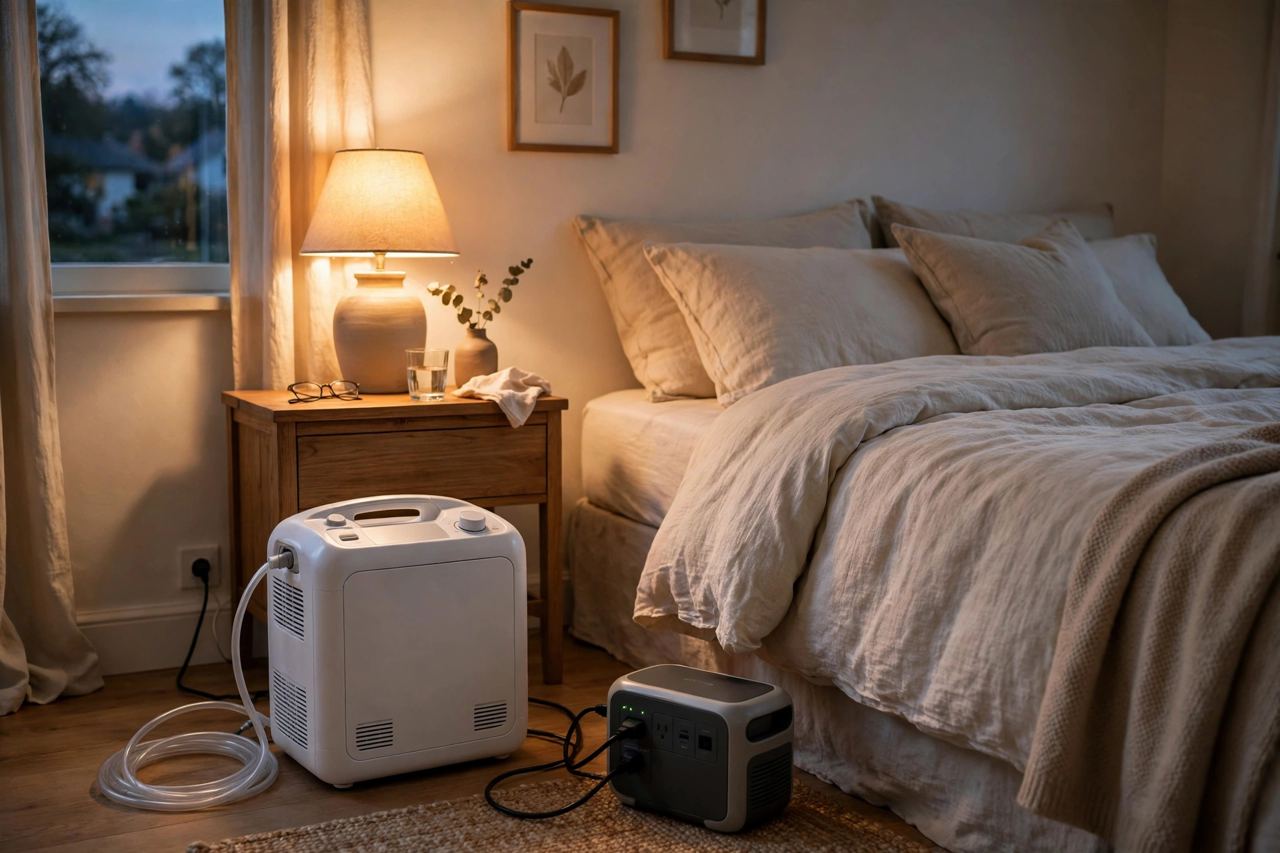
How many watts does an oxygen concentrator actually draw?
An oxygen concentrator’s draw depends on which of two families it belongs to, and the gap between them is roughly tenfold. The makers publish the numbers; these are theirs, not ours.
| Machine | Maker’s figure | Type |
|---|---|---|
| Inogen One G5, setting 2 | ~19W | Portable, pulse-dose |
| Inogen One G5, setting 6 | ~62W | Portable, pulse-dose |
| Inogen At Home, setting 2 | 100W | Stationary, 5 LPM |
| Drive DeVilbiss 525DS | 310W average | Stationary, 5 LPM |
| Philips EverFlo | 350W average | Stationary, 5 LPM |
| Drive DeVilbiss 1025 | 639W average | Stationary, 10 LPM |
Three things in that table matter more than the rest. First, the portable’s draw climbs steeply with its setting — Inogen’s own brochure for the One G5 runs from 14.6 watts at setting 1 to 61.5 watts at setting 6 — so a portable’s runtime is set by the prescription, not by a single headline number. Second, the efficient stationary machine is real: Inogen’s At Home uses 100 watts at setting 2, against 310–350 watts for the common 5-liter boxes, because its power supply is rated 275 watts maximum where the older designs simply draw more. Third, the 10-liter high-flow machines are in a class of their own at over 600 watts; almost nothing in the portable-station world runs one for long. Your machine’s rating plate — on the back, in watts or in amps (amps × 120 = watts) — is the number to plan from. The table is what the plate is likely to say.
Runtime by station size and concentrator
| Station size | At 100W | At 310W | At 350W |
|---|---|---|---|
| 500Wh | ~4.3 hours | ~1.4 hours | ~1.2 hours |
| 1,024Wh | ~8.7 hours | ~2.8 hours | ~2.5 hours |
| 2,073Wh | ~17.6 hours | ~5.7 hours | ~5.0 hours |
| 3,600Wh | ~30.6 hours | ~9.9 hours | ~8.7 hours |
Read that table the way an outage feels. On a 350-watt EverFlo-class machine, a 1,000Wh station is a bridge — it covers a short outage and buys time to get a generator running or a cylinder swapped in, and it does not cover a night. The 2,000Wh class buys an evening, not a sleep. Only the 3,600Wh class crosses the 8-hour line, and it crosses it with less than an hour to spare. Run the same math for a full day and the honest answer is that no single portable station does it: 350 watts for 24 hours is 8,400 watt-hours delivered, roughly 9,900 watt-hours of nameplate battery. Multi-day coverage for a stationary concentrator is a layered plan — station for the silent hours, a way to recharge by day (solar, or a generator run in the morning, the setup in our automatic backup page), and cylinders underneath it all. Our Power Station Size Calculator runs this arithmetic for your own machine’s watts and the hours you need to cover.
Score out of 10
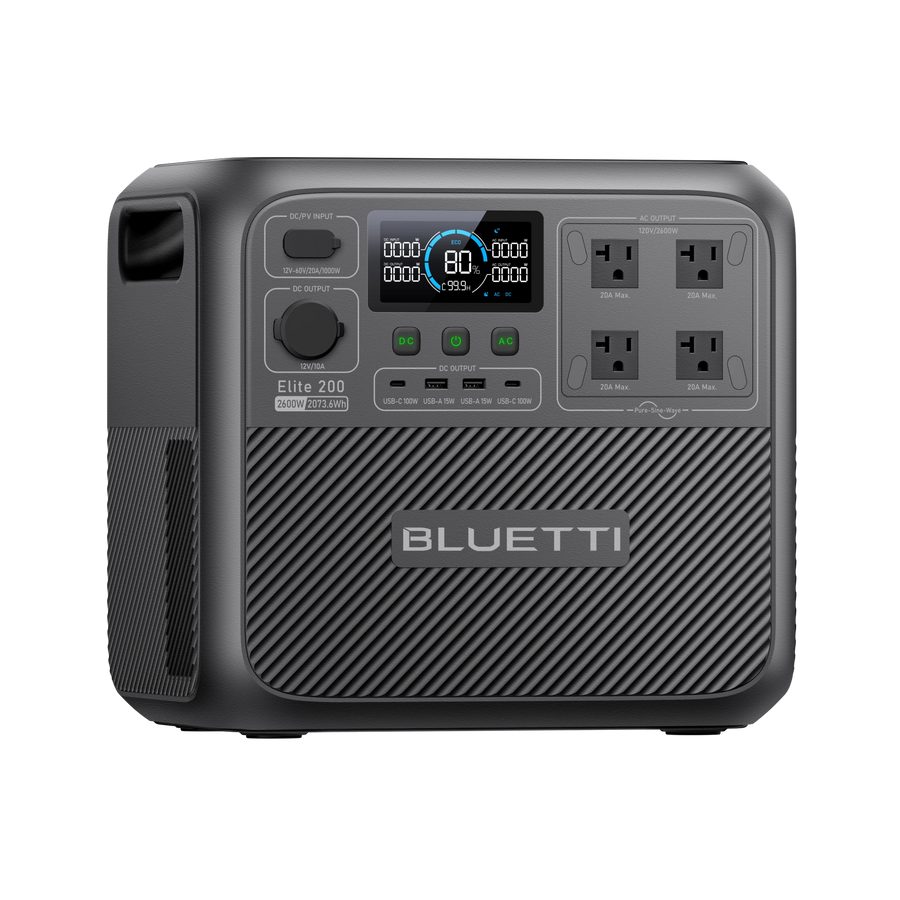
Bluetti Elite 200 V2
2,073.6Wh: about 5.7 hours at 310W or 5 hours at 350W — the bridge that covers an evening, and our CPAP comparison's multi-night pick.
Check the priceWhy is a concentrator so much harder to run than a CPAP?
A concentrator is harder to run than a CPAP because it draws about five times the power and never cycles off. A CPAP without its heated humidifier draws roughly 40 watts and sleeps when you do; a stationary concentrator draws 310–350 watts continuously, day and night, because it is separating oxygen from room air the whole time it runs. That is why the station that gives a CPAP two to three nights gives a concentrator a single afternoon. The comparison is not a warning against stations — it is the reason the sizing conversation for oxygen starts at the 2,000Wh class and treats anything smaller as a bridge, where the CPAP conversation can honestly start at 500Wh.
Does the flow setting change the runtime?
Yes — the flow setting changes a concentrator’s runtime, on both families, and it is the second-biggest lever after machine type. On the DeVilbiss 525DS, Drive publishes 310 watts average but 275 watts at 1.2 liters per minute and below, about an 11% saving that stretches a 2,073Wh station from roughly 5.7 hours to about 6.4. On the Inogen One G5 the swing is far bigger: 18.7 watts at setting 2 against 61.5 watts at setting 6, which is the difference between about 46 hours and about 14 hours from a 1,024Wh station. Read that as information about your own machine’s appetite — never as a reason to run a lower setting than the one prescribed. The setting is a medical decision; the battery is sized around it, not the other way round.
What size power station covers a full night on oxygen?
A full night on a stationary concentrator takes about 3,300Wh of nameplate battery at 350 watts — 350 × 8 hours, divided by 0.85 for the losses — and about 2,900Wh at 310 watts. In the stations we have compared, that means the 3,600Wh class: an EcoFlow DELTA Pro-class box runs about 8.7 hours at 350 watts and about 9.9 at 310. Everything smaller is a partial night, and a partial night that ends at 3 a.m. is a plan with a hole in it — if the station cannot cross the whole night, the honest setup pairs it with the cylinder for the small hours, or with a second layer that wakes nobody. For a portable concentrator the night is easy by comparison: at setting 2’s roughly 19 watts, even a 500Wh station covers the night several times over, and the portable’s own battery — up to about 13.5 hours at setting 1 on Inogen’s double battery — stacks underneath the station’s hours.

Sour Patch Kids (5 lb)
The bulk bag is the economical way to run candy mode: sour gummies sit squarely in the low-fat, high-sugar family that puffs into crisp bites in the dryer, and five pounds fills a lot of trays.
$20.99 from Amazon
Robinair 13203 Vacuum Pump Oil
A pump that runs quiet and pulls nothing is very often an oil problem — this is the replacement our maintenance guide names.
$16.79 from Amazon
JB Black Gold Pump Oil
JB’s Black Gold is the other pump oil freeze dryer owners keep on the shelf for the same job.
$54.50 from AmazonCan a power station switch over by itself when the power fails?
Some power stations can switch over by themselves, and for oxygen that feature matters more than raw size. A station with a rated EPS or UPS switchover — the Anker SOLIX C1000 in our CPAP station comparison lists one under 20 milliseconds — carries a plugged-in machine through the flicker without it ever seeing the gap. On a station without a rated switchover, the working setup is pass-through: sleep with the concentrator plugged into the station and the station plugged into the wall, so the battery is already in the path when the grid drops. Our pass-through explainer separates the three terms sellers blur. Two limits stay honest: a concentrator’s compressor motor wants clean power, and every station in our comparisons puts out pure sine wave — a cheap modified-sine inverter is the wrong tool here — and no consumer station is sold or certified as life-support equipment. Several makers say so in their own manuals. The station is one layer of the plan your supplier signs off on, never the whole plan.
The layered plan that actually covers an outage
- The cylinder is the floor. A standard E cylinder holds about 680 liters — roughly 5.5 hours at 2 liters per minute — and asks for no electricity, no inverter, and no warning time. If your supplier has not set a backup cylinder up, that conversation comes before any battery purchase.
- The station is the bridge. Sized from your machine’s plate watts with the table above: 2,000Wh class for an evening on a stationary machine, 3,600Wh class for a night, almost any size for a portable.
- Recharge is the second day. A station emptied overnight needs a way back by morning — solar input on the roof or in the yard, or a generator run while the house is awake. A battery with no refill plan is a one-night answer.
- Tell the utility and the supplier before the storm. Many utilities keep a medical-baseline or life-support register that changes how outages are notified and prioritised, and suppliers plan emergency deliveries around the customers they know about. Both phone calls are free and both belong in the plan.
Viewers also searched for these items.
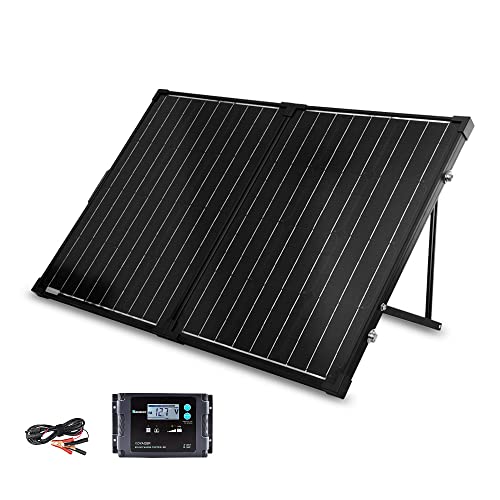
Renogy 100W Solar Suitcase
A folding suitcase panel from Renogy for the same job — easy to store with the station and quick to set out when the power goes.
$154.98 from Amazon
EcoFlow DELTA 2 Max
2,048Wh — the other 2kWh-class bridge, and our home-backup comparison's top score.
$977.00 from Amazon
Jackery Explorer 2000 v2
Same fridge runtime as the others, in a 39.5 lb box one person can actually move at midnight.
$999.00 from AmazonFrequently Asked Questions
How long will a 1,000Wh power station run an oxygen concentrator?
About 2.5 hours on a 350-watt stationary concentrator, about 2.8 hours at 310 watts, and about 8.7 hours on an efficient 100-watt stationary machine at a low setting. On a portable pulse-dose unit at a middle setting it runs past 40 hours. The machine, not the station, sets the answer.
How long will a power station run a portable oxygen concentrator?
A long time, because portables sip. An Inogen One G5 draws about 19 watts at setting 2 and about 62 watts at setting 6 by Inogen’s own figures, so a 1,024Wh station runs it roughly 46 hours at setting 2 or 14 hours at setting 6 — and the portable’s own battery carries it through any gap while the station recharges.
Can a solar generator run an oxygen concentrator all night?
Only the biggest class can, on a stationary machine: a full 8-hour night at 350 watts needs about 3,300Wh of battery, so a 3,600Wh station just covers it. Solar panels do not change the night math — they refill the battery the next day, which is what makes a second night possible.
What happens to a concentrator when the battery runs out mid-night?
The concentrator stops, and its alarm sounds — which is why a station that cannot cross the whole night should not be the only layer. The backup cylinder, a station with a rated fast switchover running in pass-through, and a household that has rehearsed the swap are the difference between an alarm that wakes someone to a plan and an alarm that wakes someone to a problem.
Prices last checked: November 18, 2026, via the tracked links above — no prices are printed on this page because station prices move weekly. Power figures are the makers’: Philips (EverFlo 350W average), Drive DeVilbiss (525DS 310W average, 275W at 1.2 LPM and below; 1025 at 639W average), and Inogen (At Home 100W at setting 2, 275W supply maximum; One G5 14.6–61.5W by setting). Runtimes are our arithmetic at 85% usable capacity, the method used across our runtime pages. Last updated: November 18, 2026.
This question sits in What People Are Asking About Backup Power — the full list of backup-power questions from real forums, each with a short answer. The station comparisons behind these numbers live on Preserve the Power.
Prices shown on this page were last checked November 26, 2026 — prices change; check before you buy.
Talk it over with other readers
The Truly Preserved Community on Facebook is where readers compare notes on food storage, water, and backup power — and where your questions help decide what we research next.