
Truly Preserved is reader-supported. If you buy through a link on this page we may earn a commission at no extra cost to you. Nobody pays for placement or scores.
THE SHORT ANSWER
Fermented dill pickles are cucumbers cured in a salt brine, not vinegar: for each gallon of container, use 4 pounds of 4-inch pickling cucumbers, 1/2 cup of canning or pickling salt, 1/4 cup of vinegar (5 percent), and 8 cups of water, with dill and spices. Hold the crock at 70 to 75 degrees F for about 3 to 4 weeks, check it several times a week, and remove surface scum or mold promptly. If the pickles become soft or slimy, or develop a disagreeable odor, discard them. Every figure on this page comes from the tested source credited at the bottom.
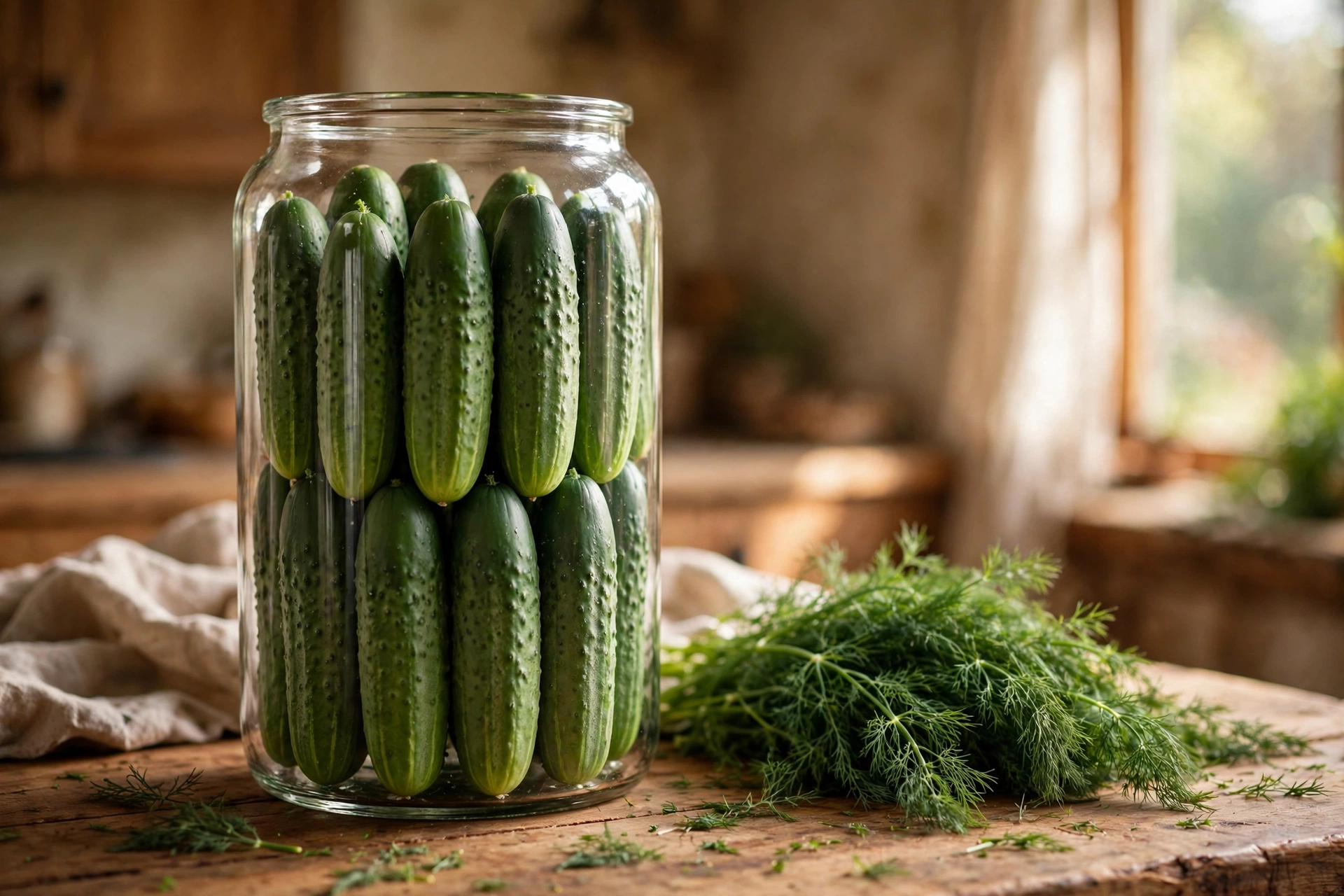
A fermented dill is a different food from the jar of vinegar pickles most people know. Nothing sour is poured over these cucumbers. They sit in salted water for weeks while bacteria already on their skins make the acid themselves, and the flavor that comes out is deeper, rounder, and unmistakably alive. It is also the slower road: the National Center for Home Food Preservation counts regular dill pickles among the ferments cured for about 3 weeks, and the full procedure below runs 3 to 4 weeks at the recommended temperature.
This guide follows the USDA tested procedure exactly, the same one behind our category flagship, how to make sauerkraut. It is part of our preservation guides, where every procedure comes from a tested source. If you want pickles this week instead of this month, the vinegar route lives at how to make dill pickles (fresh-pack).
What You Need
The recipe is written per gallon of container capacity, so scale it to your crock: 4 pounds of 4-inch pickling cucumbers, 2 tablespoons of dill seed or 4 to 5 heads of fresh or dry dill weed, 1/2 cup of canning or pickling salt, 1/4 cup of vinegar (5 percent), and 8 cups of water. Optional additions, in the amounts the source lists: 2 cloves of garlic, dried red peppers, and 2 teaspoons of whole mixed pickling spices. Use fresh cucumbers, and cut a 1/16-inch slice off the blossom end of each one and discard it — the blossom may contain an enzyme which causes excessive softening of pickles — while leaving 1/4 inch of stem attached.

Morton Canning and Pickling Salt, 4 lb
The recipe specifies canning or pickling salt by name, and this is that salt — the brine's safety mechanism, measured at 1/2 cup for every gallon of container.
$2.68 from Amazon
SOLIGT Glass Fermentation Weights, 4-Pack
A weight is what keeps every cucumber under the brine for the full 3 to 4 weeks, and these glass weights sit inside the crock doing exactly that job.
$11.99 from Amazon
Ball Half-Pint Mason Jars, 12-Pack
Fully fermented pickles get portioned into jars for the refrigerator or the canner, and this half-pint case covers the tasting jars and gifts from a crock batch.
Check AvailabilityBefore You Start
Three rules from the source govern this whole ferment. First, the salt is not seasoning you can trim: the National Center warns plainly, do not attempt to make sauerkraut or fermented pickles by cutting back on the salt required, because in fermented foods salt favors the growth of desirable bacteria while inhibiting the growth of others. Second, use canning or pickling salt — flake salt varies in density and is not recommended for pickled and fermented foods. Third, pick the room before you fill the crock: the procedure ferments at 70 to 75 degrees F, and temperatures above 80 degrees F make pickles too soft during fermentation.
How to Make Fermented Dill Pickles, Step by Step
- Wash and trim the cucumbers. Wash the cucumbers. Cut a 1/16-inch slice off the blossom end and discard it. Leave 1/4 inch of stem attached.
- Layer the container. Place half of the dill and spices on the bottom of a clean, suitable container. Add the cucumbers, then the remaining dill and spices.
- Make the brine. Dissolve the salt in the vinegar and water and pour it over the cucumbers.
- Cover and weight. Add a suitable cover and weight so the cucumbers stay under the brine for the whole cure.
- Ferment. Store where the temperature is between 70 and 75 degrees F for about 3 to 4 weeks. Temperatures of 55 to 65 degrees F are acceptable, but the fermentation will take 5 to 6 weeks. Avoid temperatures above 80 degrees F, or the pickles will become too soft.
- Check several times a week. Fermenting pickles cure slowly. Check the container several times a week and promptly remove surface scum or mold.
- Judge the batch honestly. Caution from the source: if the pickles become soft, slimy, or develop a disagreeable odor, discard them.
- Store or can. Fully fermented pickles may be stored in the original container for about 4 to 6 months, provided they are refrigerated and surface scum and molds are removed regularly. Canning is the other option, with the times in the table below.
The Numbers: Brine, Temperature, and Time
| Figure | Tested value |
|---|---|
| Brine per gallon of container | 1/2 cup canning or pickling salt, 1/4 cup vinegar (5 percent), 8 cups water, per 4 pounds of cucumbers |
| Fermentation temperature | 70 to 75 degrees F (55 to 65 degrees F acceptable, slower) |
| Fermentation time at 70 to 75 degrees F | About 3 to 4 weeks |
| Fermentation time at 55 to 65 degrees F | 5 to 6 weeks |
| Temperature to avoid | Above 80 degrees F — pickles become too soft |
| Refrigerated storage, fully fermented | About 4 to 6 months, with scum and molds removed regularly |
To can fully fermented pickles: pour the brine into a pan, heat slowly to a boil, and simmer 5 minutes. Fill jars with pickles and hot brine, leaving 1/2-inch headspace, adjust lids, and process in a boiling-water canner:
| Style of pack | Jar size | 0–1,000 ft | 1,001–6,000 ft | Above 6,000 ft |
|---|---|---|---|---|
| Raw | Pints | 10 minutes | 15 minutes | 20 minutes |
| Raw | Quarts | 15 minutes | 20 minutes | 25 minutes |
The source also describes a low-temperature pasteurization option for better texture: hold the jars in water maintained at 180 to 185 degrees F for 30 minutes, checking with a candy or jelly thermometer that the water stays at least 180 degrees F the whole time; temperatures higher than 185 degrees F may cause unnecessary softening.
Not every cucumber in the garden haul belongs in the crock. The overflow freezes or gets eaten fresh, and these are the two tools that side of the job runs on.

Mrs. Wages Pickling and Canning Salt
A second bag of pickling salt keeps the iodine-free salt the brine depends on in stock, so the next batch is not improvised with iodized table salt.
$19.32 from Amazon
Ziploc Freezer Quart Bags
Quart freezer bags are the simple backup for overflow cucumbers and opened-jar pickles that need to move to cold storage quickly.
$26.48 from AmazonCommon Mistakes
Cutting back the salt. The source’s caution is direct: do not attempt fermented pickles with less salt than the recipe requires. Salt is the safety mechanism here, not a flavor dial.
Leaving the blossom end on. That 1/16-inch slice comes off for a reason the source names — blossoms may contain an enzyme which causes excessive softening of pickles.
Fermenting somewhere hot. Above 80 degrees F the pickles go too soft during fermentation. A warm garage in August is the classic way to lose a crock.
Ignoring the surface. The procedure says to check several times a week and promptly remove surface scum or mold. A crock you forget for a fortnight is a crock you may have to throw out.
Trying to rescue a failed batch. Soft, slimy, or disagreeable-smelling pickles are discarded, per the source. There is no step that fixes them. Our troubleshooting ferments guide walks the same criteria in full.
Storage and Shelf Life
Fully fermented pickles keep in their original container for about 4 to 6 months in the refrigerator, as long as surface scum and molds are removed regularly. Canned pickles, processed with the times above and stored cool and dark with seals intact, hold their best quality for about a year like other home-canned pickles. Either way, the refrigerator batch is a living food: keep it cold, keep it covered, and keep checking the surface.
Viewers also searched for these items.

Ball Regular Mouth Canning Lids, 96 Count
Canning fully fermented pickles assumes fresh lids when the procedure says to adjust lids and process; a new flat on every jar is how the seal forms.
$36.99 from Amazon
Etekcity Digital Kitchen Scale
The recipe is built on 4 pounds of cucumbers per gallon of container, and a kitchen scale is how you know the crock is loaded at the tested proportion.
$9.99 from Amazon
ThermoPro Instant-Read Thermometer
The low-temperature pasteurization option holds water at 180 to 185 degrees F for 30 minutes, and a thermometer is how you prove it never dropped below 180.
$8.99 from AmazonFrequently Asked Questions
Why is there vinegar in a fermented pickle?
Only 1/4 cup per gallon, as the tested recipe is written. The souring itself is done by fermentation over 3 to 4 weeks; the small amount of vinegar is part of the recipe’s tested proportions, and the source cautions against altering vinegar, food, or water proportions in a recipe.
How long do fermented dill pickles take?
About 3 to 4 weeks at 70 to 75 degrees F. At 55 to 65 degrees F, expect 5 to 6 weeks.
Can I use less salt for a lower-sodium pickle?
Not in a ferment. The National Center cautions against cutting back the salt in fermented pickles, because the salt is vital to safety and texture. Reduced-salt pickles belong to the fresh-pack, vinegar-acidified recipes instead.
How do I know a batch has failed?
The source’s test is plain: if the pickles become soft, slimy, or develop a disagreeable odor, discard them.
Procedure, brine, fermentation temperatures and times, and canning times: USDA Complete Guide to Home Canning, Guide 6, “Fermented Dill Pickles,” via the National Center for Home Food Preservation.
Prices shown on this page were last checked November 26, 2026 — prices change; check before you buy.
Talk it over with other readers
The Truly Preserved Community on Facebook is where readers compare notes on food storage, water, and backup power — and where your questions help decide what we research next.